
Image

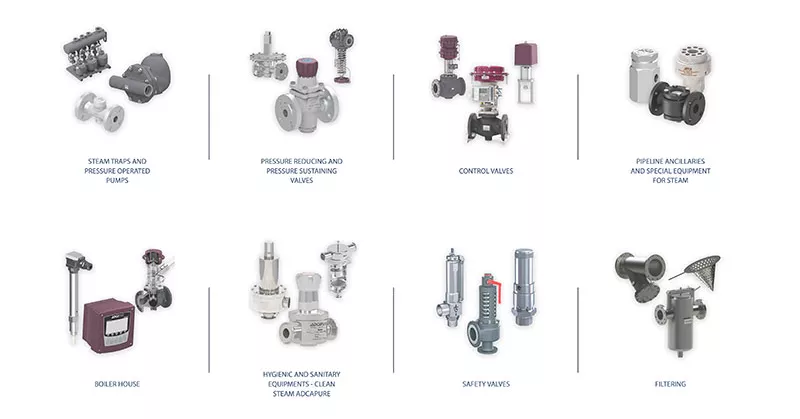
An industrial valve is a piece of mechanical hardware with a deceptively simple job: open, close, or throttle the path of a fluid. That is all. The hard part lies in choosing one. Across chemical plants, water networks, refineries, food lines, and HVAC installations, industrial valves show up everywhere a fluid moves under pressure, and a piping system that lacks the right one will fail long before its scheduled service life. Knowing what each family of valves was designed for is, in practical terms, what separates a reliable installation from a maintenance headache.
A ball valve relies on a perforated sphere mounted on a pivot. Rotate the sphere a quarter turn and the line is open or shut, no intermediate steps. That speed is precisely why operators favour them in shutoff service for both liquids and gases. The seal is tight, the actuation is light, the moving parts are few. Maintenance windows are short and failures rare, which is why you find ball valves in everything from compressed-air rigs to high-pressure gas distribution.
Globe valves play a different role. Their internal geometry forces the fluid to make an S-shaped detour around a moving disc, and that detour is what gives them their fine throttling capability. When a process needs flow regulated rather than just stopped, the globe valve earns its place. The trade-off is pressure drop: that same internal path costs energy. Engineers accept the cost when stable, repeatable control matters more than efficiency.
Gate valves belong to a different philosophy again. The internal wedge slides perpendicular to the flow, and once fully retracted leaves an almost unobstructed bore. Pressure drop drops to a minimum. They are not throttling devices, and using one half-open will chew up the seat in months. Their territory is on/off duty in long-distance pipelines, steam lines, and any application where full closure with negligible head loss is the requirement.
Picking a valve is a question of matching service conditions to design philosophy. Fluid type, working pressure, working temperature, flow rate, allowable pressure drop, frequency of operation, available actuation — all of these enter the calculation. A wrong choice does not always announce itself immediately. Sometimes a mismatched valve degrades quietly for a year and only fails when the plant least expects it.
Flow rate sets the size and the family. Each valve type has a characteristic flow coefficient (Cv or Kv) that tells you how much fluid will pass at a given pressure differential. Undersize the valve and the system starves; oversize it and throttling control becomes coarse and unstable. There is also an energy bill attached: a poorly chosen valve adds parasitic losses that compound across the lifetime of the installation.
Pressure narrows the field fast. ANSI Class 150 hardware is not the same animal as Class 1500 or 2500 hardware. Body wall thickness, bonnet design, stem packing, and bolting all scale with rated pressure. Ball and gate valves dominate the high-pressure end because their geometry handles the load cleanly. Material selection follows the same logic — carbon steel, stainless, duplex, or alloy 625 depending on what the fluid does to metal at that pressure and temperature.
High-pressure service punishes weak design. Pressure relief valves and safety valves protect equipment from overpressure events by releasing fluid above a set point. Control valves, working alongside instrumentation, hold process variables within their setpoint band during normal operation. The combination keeps the plant inside its design envelope; remove either component and the safety case collapses.
For liquid duty, ball valves and butterfly valves cover most of the requirements. Butterflies are lighter, cheaper, and faster to actuate, which makes them attractive in large-diameter water lines and cooling loops. Ball valves give the better seal when zero leakage matters. Diaphragm valves come into play with corrosive or hygienic fluids, where the wetted surface must be isolated from the working mechanism — pharmaceutical and food applications mostly.
Control valves are the workhorses of any process that does not run at a single fixed condition. They modulate. A reactor heating up, a column changing throughput, a tank receiving variable feed — all of these need a valve that responds to a signal and lands accurately at the requested position. Without that capability, automation does not exist; you simply have a series of manual operations under remote supervision.
Butterfly and diaphragm valves share a common maintenance logic even if their internals differ. Visual inspection of the body and seat goes first, looking for wear marks, deposits, and any sign of leakage past the seal. Stems and shafts get cleaned and lubricated where the design allows. Diaphragms are consumables — they have a finite cycle life and should be replaced on schedule rather than on failure. A well-kept logbook beats reactive maintenance every time.
Check valves get neglected because they have no operator handle. That is a mistake. Their job — preventing reverse flow — is silent until it fails, and when it fails it can damage pumps, contaminate upstream sections, or trigger water-hammer events that crack pipework. Sediment build-up under the disc, seat erosion, and hinge-pin wear are the usual culprits. Periodic inspection at agreed intervals catches these issues before they become incidents.
The seat is where the seal happens. Erosion, cavitation, and chemical attack all degrade it over time, and a worn seat means a leaking valve regardless of how good the rest of the assembly looks. Lapping, machining, or replacing the seat ring are skilled operations; some seats can be reground in place, others demand workshop equipment. Done well, this single operation can extend a valve's useful life by years.
The industrial-valve market has been quietly absorbing the same digital wave that touched the rest of the plant. Smart valves now ship with built-in position feedback, vibration sensors, and condition-monitoring electronics that talk back to the control system over fieldbus or wireless protocols. Operators see degradation curves before failure, schedule interventions during planned shutdowns, and reduce unplanned downtime. The hardware looks similar; the data behind it does not.
Materials have moved on too. Duplex and super-duplex stainless steels handle aggressive chlorides that would pit standard 316 in months. Nickel-based alloys cope with both temperature and corrosive attack in the petrochemical sector. Engineered polymers and PTFE composites lighten valves where weight matters, and new ceramic coatings extend seat life in abrasive slurry service. Each of these has a niche; none is a universal replacement for traditional carbon-steel hardware.
Operation has become less manual. Pneumatic and electric actuators are now standard on any valve that needs to be cycled regularly, and modern designs reduce the torque needed at the stem so smaller actuators do the same job. Quick-acting trip mechanisms protect operators from the consequences of a mishandled emergency closure. The trend is unmistakable: human force is being engineered out of the loop, replaced by repeatable, instrumented motion.