
Image

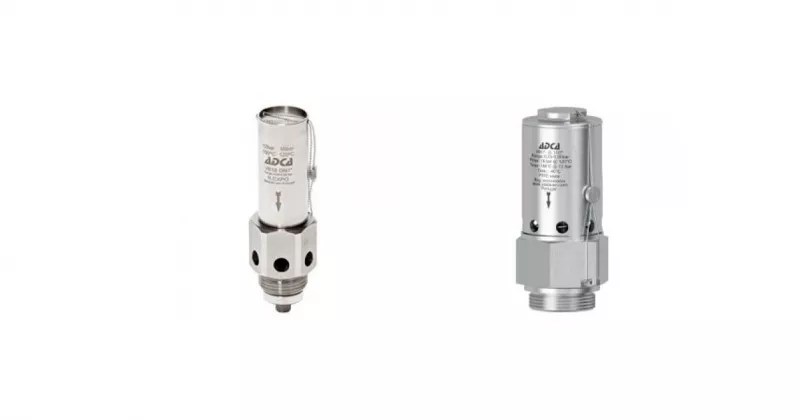
A 50,000-litre storage tank can collapse like a fizzy-drink can when it is emptied too quickly without letting air in. No exaggeration: atmospheric pressure puts more than ten tonnes per square metre on the outer surface. With nothing inside to push back, the walls give way. The vacuum breaker valve exists for exactly this reason. Under normal conditions it stays closed and goes unnoticed. When the internal pressure falls below a safe threshold, the valve opens and admits outside air until the pressures equalise. As simple as that, as necessary as that. At CDF Teccon we supply this equipment to industrial plants across Spain, and what follows lays out plainly how they work, when they are needed and how to choose the right model.
The mechanism is deliberately simple. Inside the valve body sits a sealing element —a disc, a ball or a diaphragm, depending on the design— held closed by atmospheric pressure or by a calibrated spring. As long as the pressure inside the pipe or vessel matches or beats atmospheric, that element does not move. The valve stays closed and plays no part in the process.
When something pulls the internal pressure down —steam condensation, draining by pumping, sudden cooling— the external atmospheric pressure pushes the sealing element inwards and the valve opens. Air flows in until the pressures equalise. The moment equilibrium is restored, the spring or gravity itself returns the disc to its closed position. There is no electronics, no power supply, no complicated moving parts. The physics of the pressure differential does all the work.
Manufacturers such as Valsteam ADCA and CDF Teccon have refined the design over decades to reach very short response times —milliseconds in the fastest models— and a fully leak-tight seal during normal operation. The VB17 model, for instance, carries a sealing seat that closes firmly enough not to leak air when it shouldn't, yet opens with no perceptible resistance the moment a vacuum forms.
The body is made of stainless steel, bronze or cast iron depending on the service. Sanitary applications —food, pharmaceuticals— call for 316L stainless steel with a polished finish. Industrial steam installations make do with cast iron or carbon steel. Body material matters because it lives in the same environment as the rest of the pipework.
The sealing element is the moving part. In many designs it is a disc made of elastomer or metal with a soft seal. Some models use a ball that rests on a conical seat. The pick between one type and another rides on the required response speed, the service temperature and the degree of tightness needed in the closed position.
The most comprehensive models carry an air inlet filter —so the incoming air is clean and does not contaminate the product— a visual position indicator and, on advanced versions, an instrumentation connection that lets the valve be watched from the control room. These extras are no whim: in a pharmaceutical plant, a HEPA filter on the air inlet can swing the difference between an accepted batch and a rejected one.
The most common confusion is to mix the vacuum breaker valve up with the pressure relief valve. They work in opposite directions. The relief valve opens when the internal pressure climbs too high, letting fluid escape to protect the vessel. The vacuum breaker opens when the internal pressure drops too low, letting air in. They are complementary, not interchangeable.
A control valve regulates flow in a modulated, continuous way. The vacuum breaker regulates nothing: it is either closed or open, no intermediate positions. The job is the one of an automatic emergency switch, not a process regulator.
Some installations want both forms of protection. A chemical storage tank, for example, may need a pressure relief valve to guard against overpressure caused by solar heating and, at the same time, a vacuum breaker to guard against vacuum caused by rapid draining. Two different risks covered by two different devices, and at CDF Teccon we supply both.
When steam flow in a pipe gets shut off, the residual steam condenses. The volume occupied by one kilogram of steam at 150 °C is roughly 1,700 times greater than the volume of the same kilogram once condensed into liquid water. That brutal contraction produces an almost instantaneous vacuum which can crush sections of pipe as if they were made of kitchen foil. The vacuum breaker valve, installed at the high points of the line, lets air in before the vacuum reaches destructive levels.
Something similar, though less dramatic, plays out on liquid transfer lines. When an elevated section of pipework drains, the liquid falls under gravity and leaves a gap behind it. With nothing filling that gap, a vacuum pocket forms which slows down the drainage and can damage the pipework. With a vacuum breaker at the high point, air flows in freely, drainage runs through without interruption and the pipework stays safe.
CDF Teccon offers vacuum breakers built for integration into complex steam and liquid circuits, with standard DIN and ANSI connections that slot into most existing installations without requiring adaptation.
Large tanks face the highest risk. The greater the surface area, the greater the total force atmospheric pressure puts on the walls. A cylindrical tank 3 metres in diameter and 6 metres high carries more than 70 square metres of exposed surface. Leave the interior without pressure and those 70 square metres take more than 700 tonnes of force. No standard atmospheric tank stands up to that.
The typical scenario: product is pumped out of the tank to be sent to a process or for loading. If the pump pulls liquid out faster than air can enter through the normal vents, the internal pressure drops. The vacuum breaker valve, mounted on the tank roof, makes up the difference by admitting the volume of air left behind by the extracted liquid.
On process tanks subjected to cyclic heating and cooling, the risk is twofold. On heating, the liquid and vapours expand and call for a relief valve. On cooling, they condense and call for a vacuum breaker valve. Two phases of the same cycle, each one needing its own protection. In chemical and petrochemical installations, the vacuum breaker gets fitted with an inlet filter to keep the incoming air from introducing moisture or particles that would contaminate the stored product.
Draining a closed vessel by gravity without letting air in is much like trying to empty an upside-down bottle while plugging the neck with your finger. The liquid either will not come out or comes out in fits and starts. In industry, that translates into longer drainage times, incomplete draining and, in the worst case, damage to the vessel.
The vacuum breaker valve clears that blockage. Every litre of liquid leaving gets replaced by a litre of air entering through the valve. Drainage runs at a steady rate and the vessel stays unharmed.
In the food and pharmaceutical industries, where complete emptying and CIP (Clean In Place) cleaning are part of the daily routine, vacuum breaker valves have to do double duty: protect the equipment and keep hygiene intact. That means stainless steel bodies with a sanitary finish, food-grade seals and sterile filters on the air inlet. A requirement, not a luxury.
First step: calculate how much air needs to enter the system and at what rate. On a tank emptied by a 100 m³/h pump, the valve has to be capable of admitting those 100 m³/h of air to make up for the volume of liquid extracted. Undersized, and vacuum builds up faster than it can be relieved, leaving the tank at risk.
Diameter, length and layout of the pipework also weigh in. A 200-metre run with several elevated sections may want more than one vacuum breaker, distributed across the high points, because a single breaker at one end will not equalise the pressure throughout the whole run in time.
Materials of the vacuum breaker have to match the process. For saturated steam, cast iron or carbon steel are usually enough. For clean steam in pharmaceutical use, 316L stainless steel with no exceptions. For aggressive chemicals, special alloys or coatings. Valsteam and CDF Teccon offer sizing tools that work out the correct model and size from process data: extraction flow rate, temperature, vessel volume and design pressure.
Relief capacity is measured in normal cubic metres of air per hour (Nm³/h) the valve can admit. An undersized vacuum breaker will not relieve the vacuum in time; an oversized one causes no technical problem but takes up more space and costs more than necessary.
Cracking pressure is the differential pressure at which the sealing element lifts off its seat. On atmospheric tanks, typical values fall between 0.5 and 5 millibar of vacuum (equivalent to 5–50 mm of water column). That cracking pressure has to be picked with care: too low and the valve will open under normal process fluctuations; too high and the tank may be damaged before the valve reacts.
For emergency situations —abrupt shutdown of a steam line, pump failure with sudden valve closure— relief capacity has to be sized for the worst case, not for normal operation. Vacuum in those conditions builds up in seconds, and the vacuum breaker has to respond just as fast.
The valve body has to take the same temperature and corrosion conditions as the pipework where it lives. For standard water and industrial steam applications, GG25 cast iron or A216 WCB carbon steel are perfectly adequate. Where chlorides, acids or products that attack carbon are around, 316 or 316L stainless steel is the reference pick. For services involving HCl, chlorine gas or extremely corrosive media, alloys such as Hastelloy C276 or Monel 400 are the answer.
Internal seals —the seat and the gasket of the moving element— set the tightness in the closed position and the maximum service temperature. EPDM covers up to 150 °C with good compatibility for steam and water. Viton (FKM) stands up to 200 °C and is more resistant to hydrocarbons. PTFE is inert to almost everything, although its mechanical resilience is lower and the seat may wear out faster under frequent opening and closing cycles.
Available connections —flange, NPT/BSP thread, tri-clover clamp for sanitary service— have to match the existing pipework. CDF Teccon's VB17 model, for example, comes in sizes from DN15 to DN100 with standard PN16 flange or threaded connections, and complies with PED (the European Pressure Equipment Directive) and ASME standards for low-pressure vessels.
The most serious scenario and, unfortunately, not an uncommon one. Industrial incident records carry dozens of cases of tanks collapsing under vacuum every year, most of them preventable with a properly sized vacuum breaker. The mechanism is always the same: the contents get extracted or condense faster than air can enter, the internal pressure drops and the walls give way inwards. The result is a destroyed tank, lost product and, in the worst case, people injured by fragments or by the spillage of the contents.
The investment in a vacuum breaker valve is a fraction of the cost of a new tank. No comparison whatsoever with the cost of an accident involving injuries. Any vessel that may run into a vacuum —through emptying, condensation or cooling— wants protection. No exceptions.
Thin-walled, large-diameter pipework is the most vulnerable. A stainless steel pipe 300 mm in diameter and 2 mm in wall thickness can deform permanently under a vacuum of just 0.3 bar. On steam lines, where condensation breeds vacuum quickly and unpredictably, the vacuum breaker valve stops the internal pressure from dropping far enough to cause damage.
The problem is not always visible. A pipe that has been through a vacuum event may be left with internal deformations that restrict flow without showing anything from the outside. Over time, those deformations turn into stress concentration points that end in cracks or ruptures. The vacuum breaker not only prevents immediate damage but also protects the long-term integrity of the installation.
Sounds contradictory: a valve that lets air in to prevent contamination. The key sits in control. Without a vacuum breaker, the vacuum sucks in air —and whatever comes with it— through any weak point in the system: gaskets, seals, glands, instrumentation connections. That ingress is uncontrolled, unfiltered, and can introduce dust, moisture, microorganisms or any contaminant present in the plant environment.
With a vacuum breaker valve fitted with a filter, air enters only where it should and under the conditions the process requires. In pharmaceutical applications, that filter may be a 0.2-micron HEPA filter that retains bacteria and spores. In food applications, a sintered stainless steel filter that blocks solid particles. Air ingress shifts from being a risk to being a controlled step in the process.
The general rule is to fit the vacuum breaker at the highest point of the section you want to protect. Vacuum builds up at the top because gases tend to gather at elevations. If the pipework has several high points —a layout with rises and falls— each may want its own vacuum breaker.
The valve has to be mounted vertically, with the air inlet pointing upwards. Fitting it tilted or upside down causes condensate to gather in the mechanism and eventually block the sealing element. It has to be accessible for inspection without the need for scaffolding or complicated dismantling, but protected from impacts, extreme weather and corrosive atmospheres.
On steam lines, the vacuum breaker goes downstream of the steam traps. Place it upstream and condensate may reach the seat, causing a poor seal or accelerated corrosion. The connection between the main pipework and the valve must not carry reductions that restrict the air flow: if the vacuum breaker admits 500 Nm³/h but the connecting pipework only lets 200 through, the protection is compromised.
On tanks, the vacuum breaker goes on the roof, at the highest point. If the tank has a dome, there. If it is flat, in the centre or near it. The connection runs through a flange or thread depending on the size and design pressure. All the bolting has to be tightened with a torque wrench following the usual star pattern for flanged joints.
On large tanks —above 100 m³— a single vacuum breaker may not cover the full relief capacity needed. Several get installed, distributed across the roof, so air enters uniformly and no pressure gradients build up inside the tank. Each valve carries its own isolation valve to allow maintenance without shutting the tank down, but those isolation valves have to be locked in the open position with a padlock or similar device during normal operation. An isolation valve mistakenly closed nullifies the protection and leaves the tank exposed.
The entire installation has to be documented: valve model, cracking pressure, relief capacity, installation date, person responsible. That record is mandatory in many jurisdictions and, mandatory or not, it is good practice because it makes maintenance and safety audits easier.
A vacuum breaker valve that has been installed for years without anyone inspecting it is a vacuum breaker that cannot be relied upon. Preventive maintenance is what separates a genuine safety device from a piece of pipework ornament.
Periodic inspections check that the disc moves freely, that the seats show no marks or scale deposits, and that the spring (if any) holds its calibration force. Frequency depends on the service: in clean-steam applications, an annual inspection may be enough; in services with corrosive products or suspended particles, every three or six months is more prudent.
Functional tests simulate the vacuum condition and verify that the valve opens at the design differential pressure. If it opens at a pressure other than the one specified, the spring wants recalibrating or replacing. Air inlet filters are cleaned or replaced according to the environmental conditions: a plant in a dusty industrial area fouls filters far faster than an indoor installation with air conditioning.
Valsteam ADCA and CDF Teccon provide maintenance manuals specific to each model, with recommended intervals, spare parts lists and step-by-step procedures. It pays to keep at least one spare vacuum breaker in stock for the most critical services. When an inspection reveals a problem, the valve gets replaced immediately and repaired in the workshop. A vessel is never left unprotected "until the spare arrives".
Rapid emptying of tanks. Steam condensation in pipework. Sudden cooling of closed vessels. Emergency shutdowns of process lines. CIP cleaning involving the drainage of hot solutions. Pump failure with simultaneous valve closure. Exothermic reactions followed by natural cooling. Each of these situations breeds vacuum, and each one wants the system capable of admitting air fast enough to prevent damage.
The question to ask at design stage is straightforward: can this vessel or pipe be put under negative pressure for any operational or emergency reason? If the answer is yes —or even "possibly"— a vacuum breaker valve is the answer, sized for the worst case, not for routine operation.
The ASME code for pressure vessels and the API 2000 standard for atmospheric tanks lay out clear requirements on when and how to fit anti-vacuum protection. In Europe, the Pressure Equipment Directive (PED 2014/68/EU) covers relief devices that protect vessels within its scope. CCPS (Center for Chemical Process Safety) guidelines add specific recommendations for chemical and petrochemical plants.
Environmental regulations also come into play. On tanks storing volatile organic compounds (VOCs), the vacuum breaker valve has to carry systems that limit emissions on opening —combined pressure-vacuum valves with emission control, for example. CDF Teccon offers models certified to PED, ASME and API standards, with full documentation for regulatory audits.
The collapse of a 20,000-litre tank does not merely destroy the tank. It destroys the product it contained, damages adjacent equipment, halts production for days or weeks and, if anyone was nearby, can cause serious injury or death. Post-incident investigations usually conclude that the vacuum breaker valve was missing, undersized or had gone years without maintenance. Regulatory fines, litigation and reputational damage that follow last much longer than the physical repair.
The cost of installing a properly sized vacuum breaker valve and maintaining it is negligible compared with any of those consequences. Not an expense: an insurance policy paid for once that earns its keep every day.