
Image

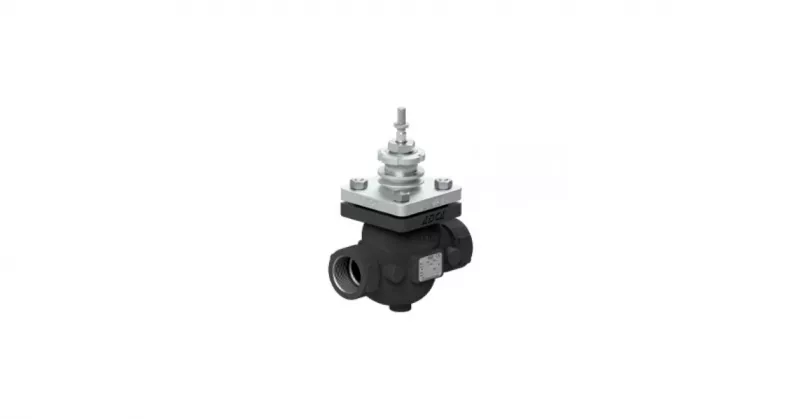
Anyone who works with industrial piping ends up running into globe valves sooner or later. They are what engineers reach for when a flow needs to be regulated with precision, not just turned on and off. The geometry inside the body forces the fluid to change direction, and that detour —which looks like a defect at first because it produces a pressure drop— is the very reason these valves throttle so well. At cdfteccon.com we have supplied them for years to process plants, steam networks and hydraulic circuits, and the same handful of questions keeps coming up. So does the same set of selection mistakes. The pages that follow lay out what you need to know to choose, install and maintain a globe valve, with no padding.
A globe valve regulates the passage of a fluid through a plug that travels up and down until it lands on a fixed seat. That movement is driven by the stem, which in turn answers either to a handwheel or to an actuator. Turn the handwheel and the plug rises or drops; the linear travel sets the flow. The name comes from the spherical body that older models had, although plenty of current designs no longer keep that round shape.
What sets this valve apart from a gate valve is the path the fluid takes once it gets inside. A gate valve lets the liquid run straight through. The globe valve does not: the fluid changes direction, climbs above the seat and drops back towards the outlet. That winding route causes a higher pressure drop, true. But it is also what lets you trim the flow with a finesse no gate valve can match —the gate, after all, was built to live in two positions, fully open or fully closed. That is why globe valves are everywhere continuous regulation is needed: steam lines, hot-water circuits, chemical dosing.
Inside the body sits a chamber split in two by the seat. Fluid comes in from one side, climbs up to the plug zone and exits on the other. The bonnet covers the upper assembly —stem, packing— and bolts to the body, or threads onto it. On the models we supply at cdfteccon.com, the bonnet-to-body seal uses graphite or PTFE depending on the working temperature.
The seat ring carries the entire closing pressure. If the plug lands badly or the seat carries a single nick, the valve leaks. That blunt. The machining quality of both surfaces matters more than any catalogue line ever will. Inlet and outlet are oriented so a technician can reach the bonnet without pulling apart half the pipework, a detail maintenance teams come to appreciate the first time a scheduled shutdown forces them into it.
Mistaking a globe for a gate is one of the most common errors on new projects. A gate valve drops a plate at right angles to the flow: once the gate is fully up, the pressure drop is minimal and the path stays virtually straight. Brilliant for isolating sections. Leave it half open to throttle a flow, though, and you get vibration, accelerated disc erosion and control so loose that the trouble starts the same week.
A globe valve takes intermediate positions in its stride. That is what it was designed for. Plug and seat work as a pair across the full travel, and the resulting flow curve —linear, equal-percentage or quick-opening, depending on the plug profile— gets picked to match the process. When the job calls for automation, you bolt an electric or pneumatic actuator on top of the stem and slot the valve into a PID loop without drama. With gate valves, that same throttling automation tends to be uncommon and rarely works as advertised.
Everything else —body, bonnet, handwheel— exists so the plug can do its work against the seat. They are the two parts that decide tightness and throttling. The plug may come flat, conical or needle-shaped, and each geometry draws a different flow curve. A needle plug gives you fine adjustment at low flows; a conical one spans wider ranges with smooth progression.
Materials depend on the service. 316 stainless with Stellite on the sealing surfaces for high-pressure steam. Bronze for cooling water in HVAC. Soft PTFE when the fluid carries particles and you want the plug to conform to the seat over minor imperfections. Plug and seat together cost only a small share of the total valve price, yet they decide service life more than any other component combined. Cutting corners here gets expensive fast.
The catalogue has grown a lot over the last few decades. Manufacturers now offer everything from compact threaded units in DN15 up to flanged bodies in DN200 rated for Class 600. At cdfteccon we stock the configurations Spanish industry asks for most: standard globe, angle, bellows-sealed, flanged and threaded. Each one answers a particular problem.
The angle variant has its inlet and outlet at 90 degrees to one another. Fluid comes in from one side and leaves at right angles. It sounds like a minor detail. In practice, it deletes an elbow from the installation, shortens the total pipework length and drops the pressure loss compared with the classic combo of a straight globe valve plus a separate elbow.
On steam lines that geometry brings a second benefit: gravity drains the condensate without help. Steam moves down, condensate pools at the bottom and the angle valve handles both jobs in a single body. Installers also welcome it on sites where space is tight, because the handwheel or actuator ends up in a more accessible position than with a straight valve. Carbon steel covers general service; stainless steel takes over wherever corrosion or aggressive fluids are involved.
The bellows is a metal element —usually AISI 316L stainless— that wraps around the stem and forms a hermetic shield between process fluid and atmosphere. In a conventional valve the stem seal lives or dies with the packing, which wears, dries out and starts to seep. Add a bellows and that external leak path simply goes away.
When is the extra spend worth it? When the fluid is toxic, carcinogenic, radioactive or just very expensive. Chlorine. Ammonia. Mercury vapour. Volatile solvents. Across European chemical plants, fugitive-emission rules now require bellows seals on a growing list of services. The bonnet itself comes reinforced to protect the bellows from mechanical overload; if the travel runs past spec, an internal stop keeps the bellows from being stretched past its elastic limit. The up-front cost stings. The packing maintenance saved and the emission penalties avoided pay it back inside a few years.
Flanges rule from about two inches upwards and on anything carrying medium-to-high pressure. They bolt together over an intermediate gasket and let you remove the valve without cutting a single section of pipe. Alignment during assembly matters: tighten the bolts unevenly and you deform the gasket, after which you get leaks that hide during the hydrostatic test and only surface once the plant is running.
Threaded connections —NPT on the American side, BSP on the European— do the job for small diameters, two inches and below as a rule of thumb. Cheaper. Smaller footprint. Quick to install with PTFE tape or sealing paste. The downside hits when you eventually need to remove the valve: threading and unthreading on a live line means cutting and rerouting pipe sections, which turns ordinary maintenance into half a day's work. For auxiliary lines, instrumentation taps and anywhere disassembly is rare, threaded works perfectly.
Body material decides valve durability more than almost any other choice on the spec sheet. Between them, carbon steel and stainless cover around ninety per cent of industrial applications in Spain. The rest gets split between specialty alloys —Monel, Hastelloy, Inconel— for very particular services that fall outside the scope of this guide.
Solid mechanical properties, sensible price, parts available everywhere. Carbon steel handles steam, process water free of chlorides, compressed air, non-corrosive hydrocarbons and most thermal fluids without complaint. It works from cryogenic temperatures all the way up to 400-450 °C depending on the grade. A216 WCB is the cast grade you will see most often on valve bodies.
Its weak point is corrosion. Once the fluid starts to bite carbon steel, the valve is on borrowed time. The outside can be painted or coated against the plant atmosphere, but the wetted surfaces stay exposed to whatever is flowing through. Demineralised water? Acid solutions? Chloride-laden environments? Carbon is not your friend there.
Stainless steel earns its place wherever carbon will not hold up. Grades 304 and 316 are the workhorses, and what separates them is one word: molybdenum. Grade 316 carries a percentage of moly that buys it resistance to chlorides and acids. In food, pharmaceutical and water-treatment plants, 316L —the low-carbon version— is effectively a requirement.
The smooth surface of stainless steel keeps residue from sticking and makes Clean In Place cleaning straightforward, a requirement in plants making food, beverages or medicines. Cost runs two to four times that of carbon depending on grade and size. In return you get valves that last longer, demand fewer shutdowns for corrosion and never contaminate the product they handle. In services where a leak of corrosive product would halt the entire plant, the price gap pays itself off the first time a breakdown does not happen.
Moving from carbon to stainless is not just a matter of writing a bigger cheque. Stainless has a thermal expansion coefficient around 50 % higher than carbon, so plug-to-seat tolerances shift differently with temperature. A seat sized for carbon may leak in stainless at high temperatures if the dimensions are not reworked.
Austenitic stainless has a nasty habit of galling when two surfaces of the same material rub each other under load. Stem and bonnet nut, for instance. The workaround is either to mix materials (a 316 stainless stem with a bronze nut, or a different stainless grade) or to apply anti-friction coatings. On automated valves with electric actuators, the operating torque shifts noticeably with the combination of body materials and dimensions, and that ripples through into actuator sizing. One detail that often slips past the project review: connect a stainless valve to carbon steel piping without an insulating gasket and galvanic corrosion sets in at the joint. Plenty of projects miss this. Leaks then appear right where the dissimilar metals meet, as expected.
Understanding how a globe valve behaves as it opens and closes is what separates an installation that works from one that gives ongoing grief. The relationship between plug position and resulting flow is called the flow characteristic, and it is not the same for every model.
A linear-characteristic plug gives the same increment of flow for every turn of the handwheel. Open 20 % and you pass 20 % of the maximum flow. It sounds logical because it is —when the valve's pressure drop dominates the total loss across the circuit.
In most industrial processes, though, the valve is just one piece in a circuit packed with pumps, heat exchangers, filters and metres of pipe. There the equal-percentage characteristic comes out on top. Each opening increment delivers a constant percentage increase over the previous flow. Translated into operating terms, control is fine at low flows and aggressive at high flows, compensating for the differential pressure swings that happen as system conditions move around.
Quick-opening is the third option. You reach maximum flow with a small fraction of plug travel. It belongs on on-off duty —pressure relief, emergency bypass— where you need to throw the valve open fast, not regulate.
Steam is probably the application that drives the largest number of globe valves installed across Spain. The reason is practical: steam wants continuous regulation —pure on-off rarely cuts it— and the working temperatures push materials and designs harder than other fluids do.
WCB carbon-steel bodies handle saturated steam up to about 425 °C. Past that, or for design pressures above Class 300, you move into stainless or alloy steels. Angle globe valves shine on steam lines because gravity drains condensate for free, which heads off water hammer —the hydraulic blow that happens when a slug of condensate slams into a high-velocity steam current. Water hammer breaks pipes, destroys valve internals and injures people. Drain properly and half the trouble on a steam line disappears.
One more detail: at high steam temperatures, the stem packing takes a beating. Serious suppliers —and at cdfteccon we are quite firm on this point— recommend bonnets with extended necks that push the packing away from the hot zone. The packing life difference runs from months to years.
The shape of the internal passage between inlet and outlet drives pressure drop, turbulent zones, noise and the tendency to cavitate. With liquids, when the local pressure drops below the fluid's vapour pressure as it crosses the seat restriction, bubbles form and then collapse violently. That is cavitation. It eats metal surfaces in weeks, not years.
Modern designs lean on Computational Fluid Dynamics to optimise the plug profile and seat geometry. Targets are clear: shrink recirculation zones that erode metal, push noise down and trim the force the fluid puts on the plug. Pressure-balanced designs —which cancel part of the fluid thrust on the plug— let you size smaller actuators and bring down the manual operating effort. That matters most on large valves, where without pressure balancing the handwheel asks for real muscle.
Threaded globe valves solve almost every small-diameter installation: instrumentation lines, drain points, sample taps, regulator bypasses, auxiliary lines in boiler rooms. Typical diameters run from a quarter of an inch up to two inches. Cheap, fast to fit, but with a few traps for the careless.
First thing on the list: thread type. NPT (tapered, American standard) and BSP (parallel or tapered, European standard) do not interchange. Force an NPT valve into BSP piping and you get a joint that looks sealed until pressure shows up. Check the standard before placing the order.
Pressure-temperature class comes next. The catalogue will say something like "PN16" or "Class 150", which tells you the maximum pressure at ambient temperature. As temperature climbs, the allowable pressure drops. The manufacturer's pressure-temperature curves are the reference you go to; generic figures off some random website will get you in trouble, because each material and design has its own curves.
Nominal diameter —DN15 to DN50 covers the normal range for threaded valves— has to match the pipe. Body material gets chosen by fluid: brass for water and air without special demands, carbon steel for steam and oils, stainless for chemicals and sanitary services. Seat type, stem packing material and actuation options (manual or automated) round out the specification.
Clean the threads on both pipe and valve before assembly. Apply PTFE tape or a sealing paste compatible with the fluid. Dirty or poorly sealed threads beat any other cause of leaks on threaded joints, by a wide margin.
There is a limit to how far you can tighten. Push it and you compress the valve body, deform the seat and create internal leaks invisible from outside but devastating for throttling. Better to stop a turn short and tighten again if it weeps than to overdo it and warp the part.
Orientation matters. Flow has to enter from below the seat —there is an arrow on the body showing the right direction. Install it backwards and nothing breaks immediately, but the plug starts working against the fluid pressure rather than with it, the operating effort climbs and the seal suffers. The stem should sit vertical and pointing up whenever the layout allows. If the piping forces it inclined or sideways, that is acceptable, but particles will build up inside the bonnet faster and maintenance turns more frequent.
Once installed: pressure test. Fill the section with water, pressurise to the test value (commonly 1.5 times the design pressure) and inspect every joint. That is the time to find problems, not after start-up.
The stem packing is the first part that wears. On well-designed valves you can re-tighten or replace it without pulling the valve off the line or depressurising the system. Snug up the gland nuts. If the weeping does not stop, swap the packing rings.
Seat and plug surfaces want a visual inspection on every shutdown. Scratches, erosion pits or scale buildup compromise the seal. Light lapping with grinding paste brings damaged surfaces back to spec in a lot of cases. If the wear runs deep, both parts get replaced together: changing only the plug or only the seat rarely ends well, because the two surfaces wear as a pair and need their mating partner reworked at the same time.
On steam or hot-fluid services, the stem lubricant cooks off over time. The valve stiffens, the handwheel turns hard and the operator ends up forcing it, which wears the mechanism even faster. Periodic cleaning and re-lubrication breaks that loop. For corrosive or abrasive services, shorten the maintenance interval and keep a spare set of internals on the shelf.
The standard globe valve covers most services, but there are spots where the angle and bellows variants pay back their extra cost. Catching those situations early saves you from expensive redesigns and from operating problems that show up months after start-up.
Steam lines with gravity condensate drainage at the bottom. Installations starved for space, where dropping an elbow frees the centimetres you need to reach other equipment. Pipework points where a 90-degree change of direction is already on the drawing, and where a straight globe plus a separate elbow would only add pressure drop and extra leak paths. Tank and vessel bottoms where complete draining requires a downward flow with no residual pockets left behind.
On chemical processes with multiple direction changes in the pipework, the strategic use of angle globe valves cuts the total number of fittings, simplifies the isometric drawing and brings down installation costs. The saving is not just in the price of the elbows you skip but in the welds or joints you no longer need to make, every one of which is a potential leak point and an inspection cost down the road.
It is not always a comfort choice. Across many European plants, fugitive-emission legislation now requires bellows seals on services with fluids classified as hazardous. Chlorine. Hydrofluoric acid. Ethylene oxide. Anhydrous ammonia. The list runs long and grows with every regulatory update.
Pharmaceutical and semiconductor industries have their own reason, and it is the reverse of the chemical one: not fluid leaving, but atmosphere getting in. Any ingress of air through the stem packing contaminates the process. In active-ingredient manufacturing or cleanroom assembly, that contamination ruins a whole batch. The bellows seals in both directions.
Severe thermal cycling —frequent start-ups and shutdowns with sharp temperature swings— is another reason to specify a bellows. Conventional packing struggles with the repeated expansion and contraction of the stem; a metallic bellows absorbs that movement without losing tightness. It is an investment that earns its keep when the alternative is changing packings every few weeks.
Above DN50 (two inches), flanges are the natural pick. They let you pull a valve out for maintenance without cutting pipework, which during a scheduled shutdown saves hours. Installation wants good alignment, gaskets matched to the service and a star-pattern tightening sequence with a torque wrench. Botched tightening is by some distance the leading cause of flange leaks.
Welded connections come into play on high-pressure or high-temperature services where flanges no longer hold the integrity needed, or where weight has to be kept low. Drawback: removing the valve means cutting and rewelding. Grooved couplings of the Victaulic or Gruvlok type are gaining ground in HVAC and fire-protection installations because they go in so fast, although in heavy industrial processes they remain a niche choice.
The final call rests on four factors: pipe diameter, design pressure and temperature, expected disassembly frequency, and budget. Across most of the industrial projects we run from cdfteccon, the answer turns out to be flanges for the main installation and threaded connections for small-diameter auxiliary lines.